Data is everywhere
Important information often sits across applications, databases, spreadsheets and older systems that were never designed to work together.
We don't approach every industry the same way. The systems, data, regulations and day-to-day realities are different. Our job is to understand those differences and build technology around them.

Most organizations already have plenty of technology. The harder questions are usually about how everything fits together.
Important information often sits across applications, databases, spreadsheets and older systems that were never designed to work together.
Teams can spend more time collecting and fixing data than actually using it to make decisions.
Moving to a new platform is rarely just a technology decision. Existing systems still have to keep the business running.
There is plenty of interest in AI. The useful question is where it can solve a real problem and be trusted in the process.
Business goals, data truth, technology change, and the people who must live with the result.
Revenue, cost, service, risk or operational visibility.
Systems, ownership, quality, movement and access.
Platforms, pipelines, analytics, AI and architecture.
The teams who run the business and the technology.

These are the kinds of environments where the way a solution is designed matters as much as the technology used to build it.
Privacy, governance, auditability and the rules that apply to your business.
Volume, quality, lineage, integration and how information moves through the organization.
Existing systems and workflows that still need to work while things change.
Security, resilience and the consequences of getting a decision or process wrong.
Performance, availability and the ability to grow without adding unnecessary complexity.
The teams who ultimately have to use, operate and maintain what gets built.

Pipelines, platforms, analytics, and AI shaped by regulation, operations, and how the business actually runs. The work can start with one problem and cross several disciplines before it is finished.
Build reliable pipelines and data foundations across disconnected systems.
Explore service → 02Make reporting easier to trust, maintain and use for decisions.
Explore service → 03Find practical uses for AI and build them around the data you already have.
Explore service → 04Modernize platforms while keeping security, performance and business continuity in view.
Explore service → 05Turn business requirements into practical architecture and technology decisions.
Explore service →How do we get our systems to share data without creating another layer of complexity?
How do we stop spending so much time fixing reports and start trusting them?
Should we move this platform to the cloud, and what should move with it?
Where would AI actually help us — and where shouldn't we use it?
How do we modernize without disrupting what already works?
How do we build something our team can operate after the project is finished?
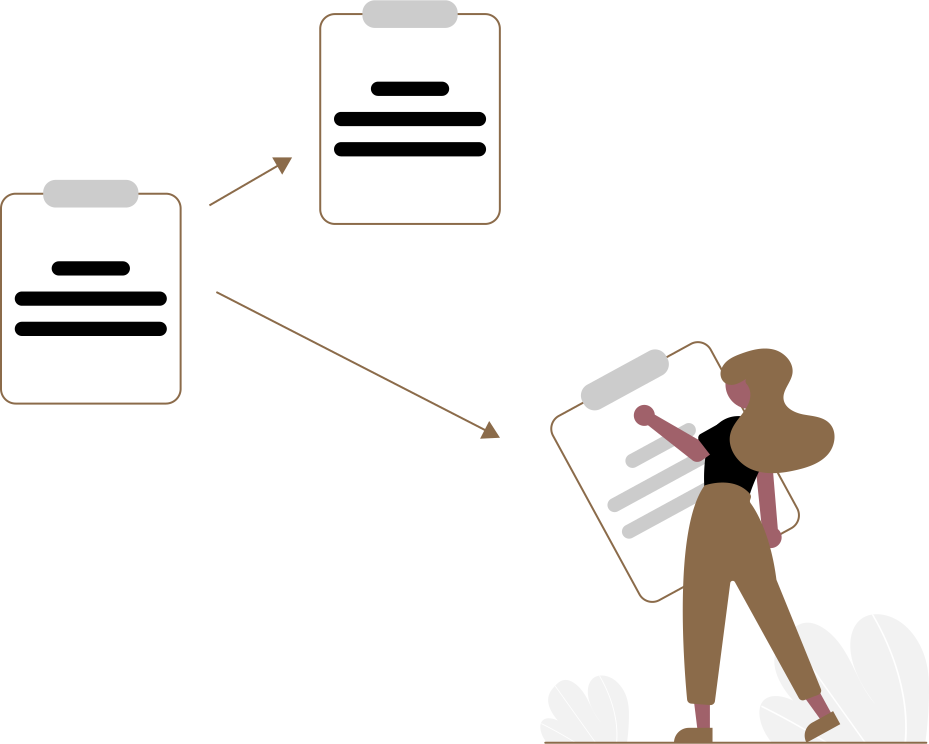
We start from how the business works today — then design data and technology change that can survive contact with operations.
We learn how the business works, what is already in place and what needs to change.
We work out a practical technical approach that fits today's environment and tomorrow's direction.
We implement the data, analytics, AI and platform components needed to make it work.
We leave room to measure, refine and evolve rather than treating delivery as the finish line.
Tell us what you're trying to improve, modernize or build. We'll help you work out what the technology should look like.
Start a conversation ↗